
Edexcel GCSE Mathematics Revision Guide: A Comprehensive Plan
As of today‚ 04/01/2026‚ Year 11 students in the West Midlands are diligently preparing for their GCSEs‚ dedicating weeks to revision amidst a potentially stressful period.
Understanding the Edexcel GCSE Maths Specification
Navigating the Edexcel GCSE Maths specification is crucial for effective revision. The curriculum is broadly divided into Number‚ Algebra‚ Ratio‚ Proportion and Rates of Change‚ Geometry and Measures‚ Probability‚ and Statistics;
Understanding the weighting of each topic is vital; some areas carry more marks than others. Familiarize yourself with the assessment objectives – problem solving‚ reasoning‚ and fluency – as these directly influence how questions are structured and marked.
Currently‚ as of 04/01/2026‚ students are actively revising‚ with exams commencing in May. The specific exam timetables vary depending on the school and examination board.
Focus on mastering the core concepts within each topic‚ as these form the foundation for tackling more complex problems. Review past papers to identify recurring themes and question types. A thorough grasp of the specification ensures targeted and efficient revision‚ maximizing your potential for success in the GCSE exams.
Exam Format and Assessment Overview

The Edexcel GCSE Maths assessment comprises three papers: Foundation Tier and Higher Tier options are available‚ catering to different ability levels. Each paper typically lasts 1 hour and 30 minutes and contributes equally to the final grade.
Papers assess a range of mathematical skills‚ including fluency in calculations‚ problem-solving abilities‚ and mathematical reasoning. Calculators are permitted in most papers‚ but students must demonstrate proficiency in non-calculator techniques as well.
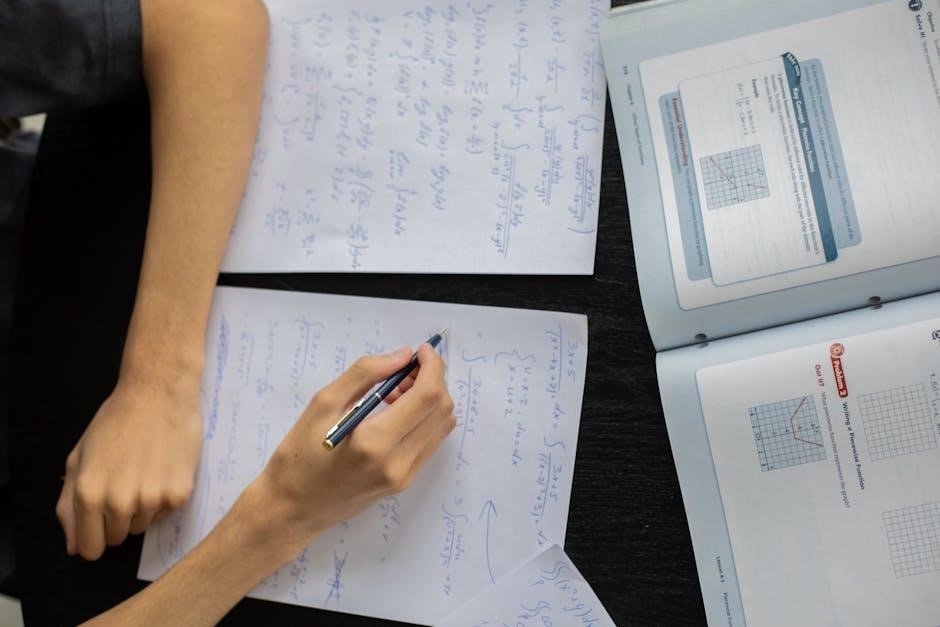
As of today‚ 04/01/2026‚ Year 11 pupils are heavily engaged in revision‚ preparing for exams starting in May. Exam timetables differ based on the school and examination board.
Understanding the question types and mark schemes is essential. Practice answering questions under timed conditions to build exam technique and manage time effectively. Familiarize yourself with the command words used in questions (e.g.‚ ‘describe’‚ ‘explain’‚ ‘calculate’) to ensure you provide the appropriate response.
Number: Core Concepts & Problem Solving

A solid foundation in number skills is crucial for GCSE Maths success. This includes mastering integers‚ decimals‚ and fractions – understanding their properties and how to perform operations with them accurately. Proficiency in converting between these forms is also vital.

Standard Form and Surds require specific techniques. Standard Form simplifies very large or small numbers‚ while Surds involve simplifying irrational numbers. Practice is key to becoming comfortable with these concepts.
Currently‚ 04/01/2026‚ students are revising intensely. Number problems often appear in context‚ demanding application of skills to real-world scenarios. Focus on problem-solving strategies‚ breaking down complex questions into manageable steps.
Regular practice with a variety of number-based questions will build confidence and fluency. Don’t neglect basic arithmetic skills; they underpin more advanced topics. Ensure you can apply number skills to solve problems involving ratios‚ proportions‚ and percentages.
Number Properties (Integers‚ Decimals‚ Fractions)
Understanding the properties of integers‚ decimals‚ and fractions forms the bedrock of numerical proficiency for the Edexcel GCSE. Integers encompass whole numbers and their negatives‚ requiring mastery of operations like addition‚ subtraction‚ multiplication‚ and division.
Decimals represent fractional parts of a whole and demand accurate calculations‚ including conversions to fractions. Fractions‚ expressing parts of a whole‚ necessitate simplification‚ addition‚ subtraction‚ multiplication‚ and division skills.
As students revise‚ nearing May’s GCSE exams (04/01/2026)‚ focus on identifying equivalent fractions‚ converting between improper and mixed fractions‚ and understanding the relationship between fractions‚ decimals‚ and percentages.
Practice applying these properties to solve real-world problems. Common errors include incorrect simplification and misapplication of order of operations. Consistent practice and careful attention to detail are essential for success. Mastering these fundamentals will significantly boost confidence in tackling more complex mathematical challenges.
Standard Form & Surds
Standard form‚ a concise way to represent very large or very small numbers‚ is crucial for Edexcel GCSE Mathematics. It involves expressing numbers as a x 10n‚ where 1 ≤ a < 10 and n is an integer.
Surds are irrational numbers involving roots‚ like √2 or √3. Simplifying surds requires factoring out perfect squares and applying the rules of radicals. Students preparing for their May GCSEs (as of 04/01/2026) should practice converting numbers into and out of standard form.
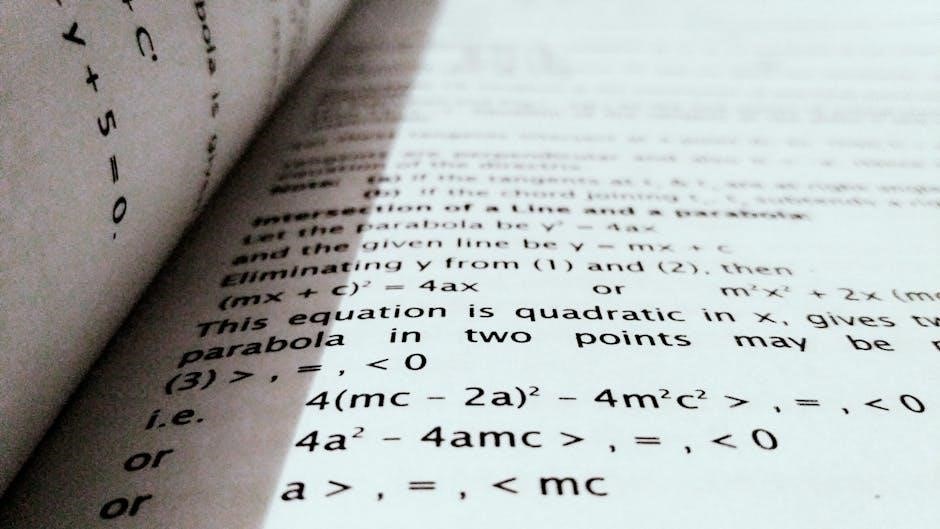
Mastering surds involves rationalizing the denominator‚ adding‚ subtracting‚ multiplying‚ and dividing surd expressions. Common errors include incorrectly simplifying radicals and failing to rationalize denominators.
Consistent practice with both standard form and surds is vital. Focus on understanding the underlying principles rather than memorizing procedures. These topics often appear in problem-solving questions‚ demanding a solid grasp of the fundamentals for success in the Edexcel GCSE exam.
Algebra: Foundations & Applications
Algebra forms a cornerstone of the Edexcel GCSE Mathematics curriculum‚ demanding a strong grasp of foundational concepts. As Year 11 pupils (as of 04/01/2026) intensify their revision for May’s GCSE exams‚ mastering algebraic manipulation is paramount.
This section focuses on simplifying expressions by combining like terms and applying the distributive property. Expanding brackets accurately is essential‚ alongside confidently solving linear equations using inverse operations.
Quadratic equations require familiarity with factoring‚ the quadratic formula‚ and completing the square. Simultaneous equations‚ solved through substitution or elimination‚ test students’ ability to work with multiple variables.
Effective revision involves practicing a wide range of problems‚ identifying common errors‚ and understanding the connection between algebraic concepts and real-world applications. A solid algebraic foundation is crucial for tackling more complex problems throughout the GCSE course and beyond.
Simplifying and Expanding Expressions
As students revise for their May GCSEs (currently 04/01/2026)‚ mastering simplification and expansion of algebraic expressions is vital for success in Edexcel GCSE Mathematics. This builds a crucial foundation for solving more complex problems.
Simplification involves combining ‘like terms’ – terms with the same variable raised to the same power. This requires careful attention to signs and coefficients. Students must accurately identify and group these terms to reduce expressions to their simplest form.
Expanding expressions utilizes the distributive property (often remembered as FOIL – First‚ Outer‚ Inner‚ Last – for binomials). Correctly multiplying terms within brackets is essential‚ avoiding common errors with negative signs.
Consistent practice with various expression types‚ including those with multiple brackets‚ is key. Understanding the underlying principles‚ rather than memorizing steps‚ will enable students to confidently tackle any simplification or expansion problem during their exams.
Solving Equations (Linear‚ Quadratic‚ Simultaneous)
With GCSE exams approaching in May (as of 04/01/2026)‚ proficiency in solving equations is paramount for Edexcel GCSE Mathematics students. This skill underpins numerous other mathematical concepts and problem-solving techniques.
Linear equations are solved through isolating the variable‚ employing inverse operations to maintain equality. Students must demonstrate a clear understanding of balancing equations and correctly applying these operations.
Quadratic equations require more sophisticated methods‚ including factoring‚ completing the square‚ or utilizing the quadratic formula. Choosing the most efficient method depends on the equation’s structure.
Simultaneous equations involve finding values that satisfy multiple equations concurrently. Techniques like substitution and elimination are crucial. Careful algebraic manipulation and accurate substitution are vital to avoid errors.
Regular practice with diverse equation types‚ coupled with a strong grasp of algebraic principles‚ will empower students to confidently solve equations during their GCSE examinations.
Ratio‚ Proportion and Rates of Change
As students revise for their May GCSEs (current date: 04/01/2026)‚ mastering ratio‚ proportion‚ and rates of change is essential for success in Edexcel GCSE Mathematics. These concepts frequently appear in problem-solving scenarios.
Direct proportion signifies a linear relationship where variables increase or decrease at a constant rate. Identifying the constant of proportionality is key. Inverse proportion‚ conversely‚ demonstrates a relationship where one variable increases as the other decreases.
Percentage change calculations require understanding of initial and final values‚ and the formula for percentage increase or decrease. Compound interest builds upon simple interest‚ applying interest to both the principal and accumulated interest.
Understanding rates of change‚ including speed‚ density‚ and pressure‚ involves interpreting units and applying appropriate formulas. Proficiency in these areas will significantly boost exam performance.
Direct and Inverse Proportion
With GCSE exams approaching in May (as of 04/01/2026)‚ a firm grasp of direct and inverse proportion is crucial for Edexcel GCSE Mathematics students. Direct proportion establishes a linear relationship: as one quantity increases‚ the other increases proportionally‚ maintaining a constant ratio.
Identifying this constant – often denoted as ‘k’ – is fundamental. Problems frequently involve finding missing values using the equation y = kx. Conversely‚ inverse proportion dictates that as one quantity increases‚ the other decreases‚ also maintaining a constant product.

The equation for inverse proportion is y = k/x. Students must practice recognizing scenarios representing each type of proportion and applying the correct formula to solve for unknowns. Understanding the graphical representation of both is also beneficial.
Successfully tackling these problems requires careful attention to detail and a solid understanding of proportional reasoning.

Percentage Change & Compound Interest
Considering the GCSE exam period beginning in May (as of 04/01/2026)‚ mastering percentage change and compound interest is vital for Edexcel GCSE Mathematics success. Percentage change calculations involve determining the increase or decrease as a percentage of the original value‚ using the formula: [(New Value ― Original Value) / Original Value] x 100.
Students must be comfortable applying this to various real-world scenarios‚ including price fluctuations and population growth. Compound interest‚ however‚ builds upon itself; interest earned is added to the principal‚ and subsequent interest is calculated on this new‚ larger amount.
The formula for compound interest is A = P(1 + r/n)^(nt)‚ where A is the final amount‚ P is the principal‚ r is the annual interest rate‚ n is the number of times interest is compounded per year‚ and t is the number of years.
Practice with both concepts is key to achieving strong exam results.
Geometry and Measures: Key Theorems & Calculations
With GCSE exams approaching in May (as of 04/01/2026)‚ a solid grasp of geometry and measures is crucial. This section focuses on core theorems and calculations essential for Edexcel GCSE Mathematics. Students must confidently calculate area‚ volume‚ and surface area of 2D and 3D shapes‚ including triangles‚ rectangles‚ circles‚ cubes‚ and prisms.
Trigonometry‚ specifically SOH CAH TOA‚ is fundamental for solving problems involving right-angled triangles. Understanding the relationships between sides and angles is paramount. Pythagoras’ Theorem (a² + b² = c²) is equally important for finding missing side lengths in right-angled triangles.
Beyond these‚ students should be proficient in angle rules‚ geometric proofs‚ and conversions between units of measurement. Accurate calculations and the ability to apply these theorems to practical problems are key to success. Regular practice and revision are highly recommended.

Area‚ Volume & Surface Area
As students revise for their May GCSEs (current date: 04/01/2026)‚ mastering area‚ volume‚ and surface area calculations is vital. This involves understanding formulas for 2D shapes like rectangles‚ triangles‚ and circles – area being the space enclosed within. For 3D shapes‚ such as cubes‚ cuboids‚ prisms‚ and cylinders‚ students need to calculate volume (the space occupied) and surface area (the total area of all faces).
Key skills include correctly identifying the dimensions needed for each formula and applying them accurately. Units are crucial; ensure consistency and correct conversions. Problem-solving often requires breaking down complex shapes into simpler components.
Practice applying these concepts to real-world scenarios. Understanding how changes in dimensions affect area‚ volume‚ and surface area is also essential for higher-level questions. Consistent revision will build confidence and accuracy.
Trigonometry (SOH CAH TOA) & Pythagoras’ Theorem
With GCSE exams approaching in May (as of 04/01/2026)‚ a strong grasp of trigonometry and Pythagoras’ Theorem is crucial. Pythagoras’ Theorem (a² + b² = c²) allows students to find missing sides in right-angled triangles. Trigonometry‚ using SOH CAH TOA (Sine = Opposite/Hypotenuse‚ Cosine = Adjacent/Hypotenuse‚ Tangent = Opposite/Adjacent)‚ relates angles to side ratios.
Students must be able to identify the hypotenuse‚ opposite‚ and adjacent sides relative to a given angle. Applying these ratios to solve for unknown angles or sides is a key skill. Understanding inverse trigonometric functions (arcsin‚ arccos‚ arctan) is also vital.
Practice problems involving real-world applications‚ like calculating heights or distances‚ will solidify understanding. Ensure calculators are used correctly in degree mode‚ and attention is paid to significant figures.
Probability: Understanding Chance & Data Analysis
As students revise for their May GCSEs (current date: 04/01/2026)‚ mastering probability is essential. This involves understanding the likelihood of events occurring‚ expressed as fractions‚ decimals‚ or percentages. Key concepts include sample space‚ mutually exclusive events‚ and independent events.
Students need to calculate probabilities of single and combined events‚ utilizing tree diagrams and Venn diagrams to visualize possibilities. Conditional probability‚ where the outcome of one event affects another‚ requires careful consideration. Understanding expected value is also important.
Data analysis links to probability through statistical measures. Interpreting data presented in tables and charts‚ and relating it to probabilities‚ is a common exam question. Practice applying these concepts to real-world scenarios to build confidence.
Statistics: Interpreting and Analysing Data
With GCSE exams approaching in May (as of 04/01/2026)‚ a strong grasp of statistics is crucial. This area focuses on collecting‚ organizing‚ and interpreting data to draw meaningful conclusions. Students must be proficient in calculating and understanding measures of central tendency – mean‚ median‚ and mode – and dispersion‚ like range and standard deviation.
Graphical representation of data is key; mastering histograms‚ scatter graphs‚ and box plots is essential. Understanding frequency distributions and cumulative frequency is also vital. Students should be able to identify patterns and trends within data sets.
Interpreting data in context‚ recognizing potential biases‚ and drawing valid inferences are important skills. Relating statistical analysis back to probability concepts strengthens understanding and exam performance.
Effective Revision Techniques for GCSE Maths
Considering the current exam preparation period (as of 04/01/2026) for Year 11 students‚ effective revision is paramount. Past papers are invaluable; consistently practicing under timed conditions builds speed and confidence. Focus on identifying weak areas and revisiting core concepts.
Spaced repetition – reviewing topics at increasing intervals – enhances long-term retention. Create flashcards for formulas and key definitions. Utilize online resources and video tutorials to supplement textbook learning.
Collaborative revision‚ such as study groups‚ can provide different perspectives and reinforce understanding. Don’t neglect self-care; adequate sleep‚ healthy eating‚ and regular breaks are crucial for maintaining focus and reducing stress during this demanding time.